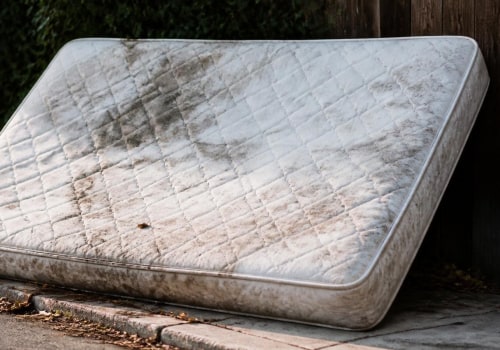
After a bad storm the instinct is to rent the biggest roll-off available and start filling it. For most of what comes out of a flooded house, that's exactly right — a dumpster is the cheapest way to move a large volume of ruined material in one go.
But a flooded house produces a handful of things that cannot legally go in that container, and most people find out the hard way: at the gate, when the hauler refuses the load, or on the invoice, as a contamination charge. Here's what to separate before you start, and what to do with each.
What a Dumpster Handles Perfectly Well
Start with the good news, because it's most of it. A standard roll-off will take soaked drywall, insulation, carpet and underlay, subfloor, ruined cabinetry, dimensional lumber, roofing, fencing, decking, and the general contents of a flooded ground floor — furniture, mattresses, boxes, clothing.
Vegetative debris is usually fine too, though check first. Many municipalities run separate storm debris collection for limbs and brush after a declared event, and if yours does, putting yard waste in a paid dumpster is money thrown away. Keep the piles separate at the curb.
Two practical notes before any of it moves. Photograph everything for your insurer first — once it's in the container it's gone as evidence. And get wet material out fast. Soaked drywall and upholstery deteriorate within days, and the longer it sits the worse the mold problem gets for everything it's touching.
Appliances With Refrigerant: The One That Catches Everyone
This is the big one, and it's the item most likely to get a load rejected.
Refrigerators, freezers, window air conditioners, dehumidifiers, heat pumps and outdoor condenser units all contain refrigerant. Under EPA Section 608, that refrigerant has to be recovered by a certified technician before the unit can be scrapped or landfilled. It is not a rule dumpster companies can waive, and it's not one you can get around by hoping nobody notices — scrap yards and transfer stations check, and the penalty lands on whoever tipped the load.
So a flooded condenser sitting in your side yard is not dumpster material. It needs a technician to recover the charge first, after which the metal shell is ordinary scrap and genuinely valuable — steel, copper and aluminum all recover well.
The same applies to your refrigerator and chest freezer, which is worth knowing because after a multi-day outage those are often the first things people want gone.
Why a Flooded HVAC System Is Rarely a Repair Job
While we're on the subject, there's a common and expensive misunderstanding about what happens to heating and cooling equipment that has been underwater.
The instinct is to dry it out and hope. Industry guidance is consistent that this doesn't work: floodwater destroys insulation inside the equipment, corrodes electrical components and contacts, and leaves silt and contaminants in places that cannot be cleaned out. A submerged unit that appears to start afterwards is generally on borrowed time, and running it risks pushing contamination through the house.
Ductwork is the part people forget entirely. Flexible duct and internally-lined rigid duct that has taken floodwater is usually a replacement item rather than a cleaning item, because the insulation holds moisture and contaminants that cleaning cannot reliably remove. If your ducts run under the house — common in coastal construction on crawl space foundations — assume they took water even if the equipment above didn't.
There's a seasonal trap here too. A unit that flooded in September often sits untouched through a mild autumn, and the problem only surfaces at the first cold snap when it gets switched to heat for the first time since the storm. Have it assessed before you need it, not during the first freeze.
Practically, that means getting an HVAC contractor out before you book the container — they can tell you what's salvageable, recover the refrigerant from what isn't, and disconnect the unit so it can be scrapped. Homeowners around the lower Cape Fear can use a local outfit like a Castle Hayne HVAC company that handles flood-damaged systems; most areas have an equivalent, and any licensed contractor can do the recovery.
The Rest of the No List
Beyond refrigerant appliances, the standard prohibited list runs roughly like this:
- Paint, solvents, motor oil, fuel and pool chemicals — household hazardous waste, requiring a separate licensed route. Most counties run a drop-off program.
- Propane tanks — pressurized, and a genuine hazard in a compactor.
- Asbestos — likely in flooring, pipe insulation and siding in anything built before the mid-1980s. If you suspect it, stop and get it tested before anything is disturbed.
- Tires — accepted almost nowhere in a mixed load, and usually surcharged heavily where they are.
- Electronics — restricted in many states, and landfill-banned in some. Worth checking your own rules rather than assuming.
- Marine fuel, bottom paint and lead-acid batteries — specific to coastal areas, and they come up constantly after a flood.
Anything on that list going in the container risks the whole load being refused, which turns one disposal problem into two.
When a Dumpster Isn't the Right Tool
A roll-off is unbeatable when you're generating debris gradually over days or weeks — a gut renovation, a reroof, a whole-house strip-out. You need somewhere to throw things as you go, and you accept losing the driveway for the duration.
It's a worse fit in three situations, all of which are common after a storm.
When it's a one-time clearout. You pay for the container size you guessed at, not the space you fill, and you do all the lifting. Full-service removal is often cheaper for the same volume and finished the same day.
When the driveway is already spoken for. After a flood it's usually holding salvage, contractor vehicles, or a POD. And if the container would need to sit on the street, that's often a permit question.
When the load needs sorting rather than dumping. This is the real difference. A dumpster is a one-way trip to landfill. A crew that sorts as it loads will pull out the metal for scrap, the appliances for recycling, and anything still usable for donation — which matters both environmentally and because appliances and metal have genuine recovery value. In coastal North Carolina, where storm cleanup is an annual fact of life, outfits that clear flood-damaged contents around Wilmington handle this as routine work and will take the items a container won't.
Plenty of jobs use both: a container for the structural strip-out, a crew for the appliances, the awkward items and the final sort.
A Workable Order
If you're staring at a flooded ground floor, this sequence saves the most money and the fewest arguments:
- Photograph everything before anything moves, for insurance.
- Separate the no-list items into their own pile, well away from what's going in the container.
- Get the HVAC assessed and the refrigerant recovered, so the equipment can legally be scrapped.
- Check for separate municipal collection of vegetative storm debris before you pay to dump it.
- Then book the container, sized for what's actually left.
- Arrange a crew for the appliances, the heavy awkward items and anything worth donating.
Most of the cost overruns after a storm come from doing these in the wrong order — renting the container first, filling it with things that shouldn't be in it, and paying twice.